Bhutan is not a theme park. It is a living kingdom with a deep culture, a royal family that is genuinely loved, a Buddhist tradition that permeates daily life, and communities that have opened their doors to visitors by choice. The respect you bring matters — not as a formality, but as the foundation of a meaningful visit.
This guide is not a list of rules designed to intimidate you. It is an honest attempt to help you understand why certain things matter here, so that your behaviour comes from understanding rather than instruction.
Dress Code
Bhutan is a conservative country. Dressing modestly is not optional when entering religious and government buildings — it is required. The standard applies to everyone regardless of gender.
- Cover your shoulders — sleeveless tops and singlets are not appropriate in dzongs, monasteries or lhakhangs
- Cover your knees — shorts are not permitted in most sacred sites
- Wear clean, presentable clothing — ripped jeans or very casual beachwear-style clothing is not appropriate in sacred spaces
- Some sites provide wraps or scarves at the entrance if you need them — your guide will let you know
Outside of religious sites, Bhutanese people dress neatly. You do not need to wear traditional Bhutanese dress as a visitor, but being generally tidy and presentable is appreciated.
Inside Temples, Dzongs and Monasteries
Remove your shoes
Always remove your shoes before entering a lhakhang or the inner courtyard of a dzong. There will usually be a clear place to leave them. If you are unsure, watch what others do or ask your guide.
Walk clockwise
When circumambulating stupas, chortens and religious structures, always walk clockwise. This is a deeply held Buddhist practice. Walking counter-clockwise is considered inauspicious. If you see others moving in one direction around a sacred structure, follow them.
Do not point your feet at altars or sacred objects
In Bhutanese and broader Himalayan Buddhist culture, feet are considered the lowest and least sacred part of the body. Pointing your feet directly at a statue, altar or religious text is disrespectful. Sit with your legs crossed or tucked to the side rather than stretched out toward an altar.
Keep your voice low
Monasteries and lhakhangs are places of prayer and meditation. Even when they are open to visitors, they remain active religious spaces. Speak quietly, do not shout to your travel companions across a courtyard, and be mindful that monks may be conducting prayers nearby.
Photography inside temples
In most temples and monasteries, photography inside the main shrine hall is not permitted. This is strictly enforced in many places. Your guide will tell you where photography is allowed and where it is not. Do not try to take sneaky photos when no one is looking — it is disrespectful to the site and to the people who maintain it.
Photography of People
Always ask before photographing people — especially monks, nuns, elderly people and children. Most Bhutanese are happy to be photographed if you ask with a smile, but assuming it is fine without asking is a form of disrespect. If someone declines, accept it gracefully.
During festivals and ceremonies, photography of the dances and performances is usually permitted from the designated viewing areas. However, photographing monks or officiants during active rituals without permission is inappropriate. Your guide will steer you on this.
The Royal Family
Bhutan's royal family is deeply respected — not out of obligation but out of genuine love. The king is a central figure in the lives of Bhutanese people in a way that is difficult to explain to outsiders without experiencing it firsthand.
Never speak disrespectfully about the royal family. Never make jokes about the king, queen or royal children. Never sit on anything bearing the image of the king or the royal crest. This is not a matter of law to be navigated — it is a matter of common decency as a guest in a country where the monarchy is genuinely beloved.
Religious Objects and Sacred Sites
- Do not touch statues, thangkas or religious objects unless specifically invited to do so
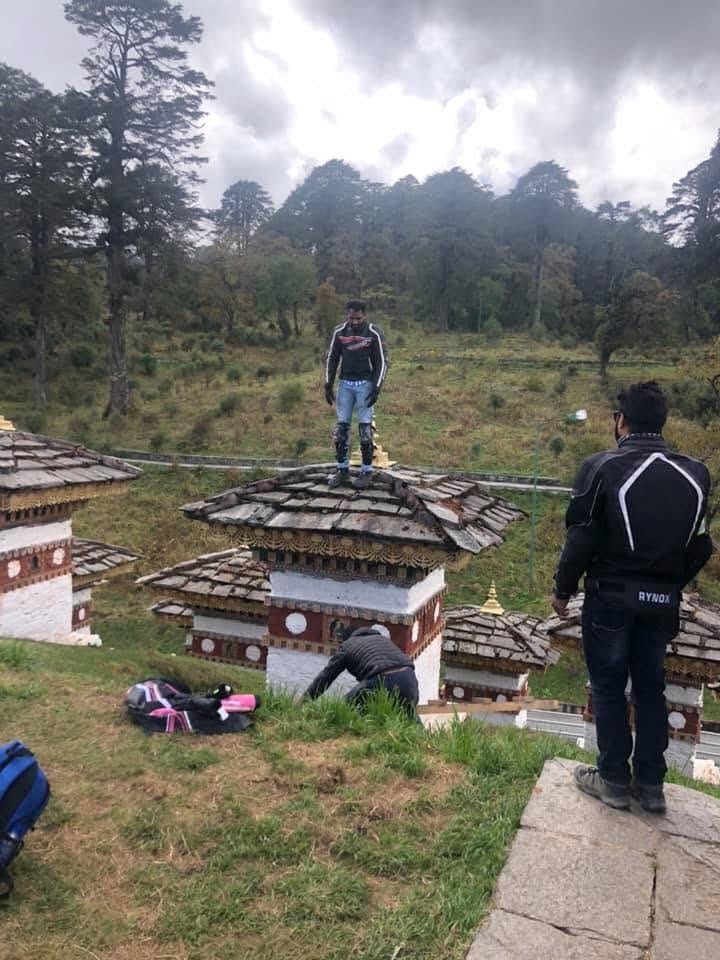
- Do not climb on chortens or stupas for photographs
- Do not remove prayer flags, mani stones or any religious markers from where they have been placed
- Prayer wheels should be spun clockwise — never counter-clockwise
- If you enter a home or farmhouse, wait to be guided to where you should sit — do not walk uninvited into private spaces
Giving and Receiving
In Bhutanese culture, giving and receiving — whether it is an object, food, money or a gift — is done with both hands, or with the right hand supported at the wrist by the left hand. It signals respect and care. You do not have to do this, but if you want to interact with locals in a way that feels culturally natural, it is a small gesture that is noticed and appreciated.
The Environment
Bhutan's forests and mountains are not backdrops — they are sacred. The country has a constitutional mandate to keep at least 60% of its land under forest cover. Littering, picking flowers at sacred sites, carving names into trees, or leaving waste in the mountains is not just environmentally harmful — it is a form of disrespect toward the country itself.
Carry out everything you carry in. Do not leave anything behind — not a wrapper, not a bottle, not a cigarette end. If you see litter left by someone else, pick it up. Bhutan's environment has been preserved by the people who live here with great care. Visitors should honour that.
A Final Word
Bhutanese people are warm, patient and rarely confrontational. If you make a mistake — wear the wrong thing, walk into the wrong area, make a cultural misstep — most people will gently correct you rather than make you feel bad. Use those moments as the learning opportunity they are.
But here is something important to understand: many Bhutanese people will not tell you when something bothers them. They think it inside. They smile, they stay quiet, and they carry it. This is part of the culture — confrontation is avoided, feelings are held inward. It does not mean everything is fine. It means they are being gracious in a way that asks something of you in return.
So do not take the silence as permission. If you are unsure whether something you are doing is appropriate, ask your guide. Pay attention to the room. Notice when people seem uncomfortable even if they say nothing. That awareness — that willingness to read beyond the spoken word — is the mark of a truly respectful guest.
Respect in Bhutan is not about following a checklist. It is about arriving with genuine curiosity, paying attention, and remembering that you are a guest in someone else's home. That attitude, more than any specific rule, is what makes a visitor welcome.