One thing that surprises many visitors is that most monuments, dzongs and cultural sites in Bhutan charge entry fees — and these are separate from your Sustainable Development Fee (SDF). Your guide handles the tickets, but it is good to know what to expect so you can budget properly.
Entry fees are set by the Department of Tourism and collected on-site. The revenue goes directly towards maintaining and preserving these sacred and historic places. In that sense, every ngultrum you pay is an investment in Bhutan's cultural heritage.
Official Monument Entry Fees
The following fees are issued by the Department of Tourism of Bhutan. All amounts are in Bhutanese Ngultrum (Nu.).
| Monument / Site | Entry Fee |
|---|---|
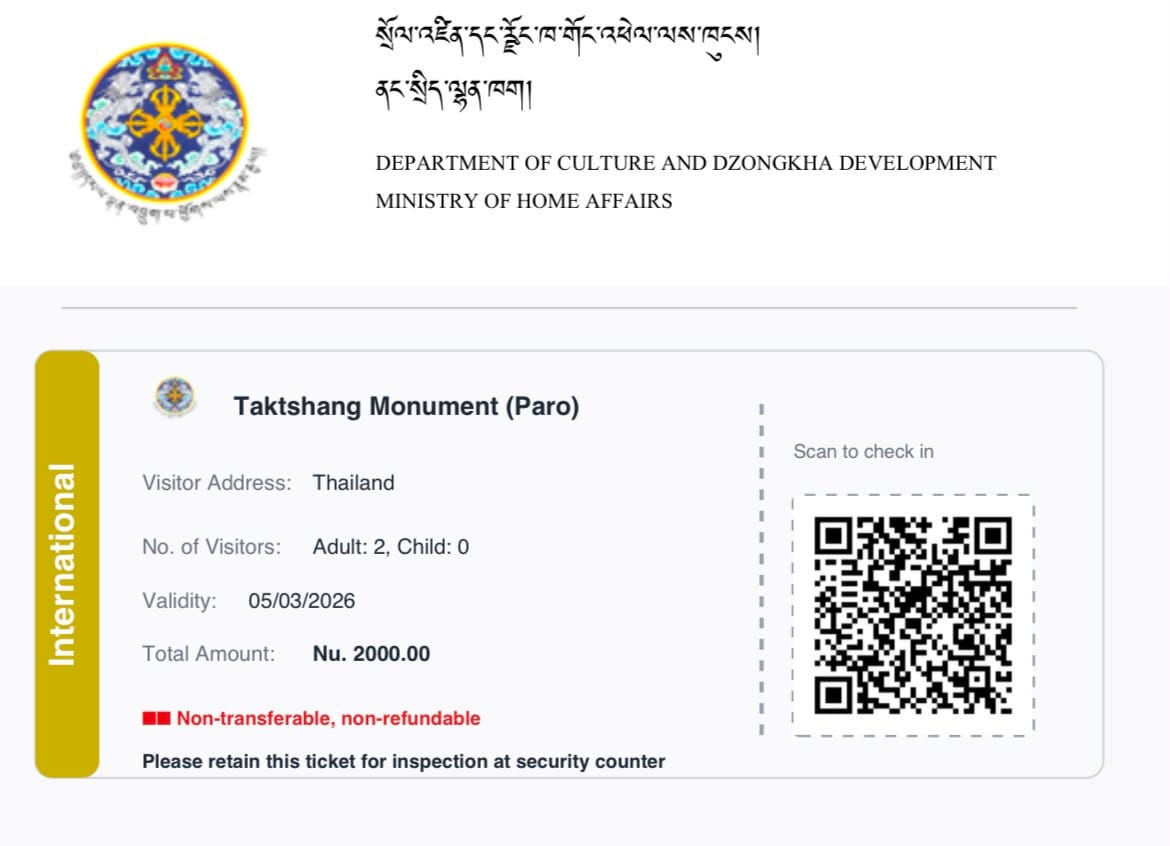
| Taktsang (Tiger's Nest) | Nu 1,000 |
| Kyichu Lhakhang, Paro | Nu 500 |
| Changangkha Lhakhang, Thimphu | Nu 500 |
| Memorial Chorten, Thimphu | Nu 500 |
| Tashichho Dzong, Thimphu | Nu 500 |
| Punakha Dzong | Nu 500 |
| Chhimi Lhakhang, Punakha | Nu 500 |
| Paro National Museum (Ta Dzong) | Nu 500 |
| Buddha Dordenma (Kuensel Phodrang), Thimphu | Nu 500 |
| Trongsa Dzong | Nu 500 |
| Royal Heritage Museum, Trongsa | Nu 500 |
| Jampa Lhakhang, Bumthang | Nu 500 |
Children aged 6 to 18 years receive a 50% discount on all monument entry fees. Children 5 years and below enter free of charge.
Other Attractions and Their Fees
Beyond the officially listed monuments, Bhutan has several other popular attractions that charge their own entry fees.
| Attraction | Entry Fee |
|---|---|
| Simply Bhutan (Living Museum), Thimphu | Nu 1,000 |
| Takin Preserve Center (Motithang), Thimphu | Nu 300 |
| Changyul Park, Thimphu | Nu 100 |
How and Where to Pay
Most monument entry fees can be paid in cash (Ngultrum) or via the GoBob app — Bhutan's widely used digital payment platform. Your guide will collect the tickets on your behalf at the entrance, so you do not need to queue separately.
It is always a good idea to carry some cash in small denominations when visiting monuments, especially in smaller towns where digital payment may not always be available.
eTickets and QR Codes
Some monuments have moved to a digital ticketing system. After payment, an eTicket is sent directly to your guide's email. At the entrance, the staff simply scan the QR code on the ticket — making the process faster and smoother, with no paper tickets to manage.
That said, not all sites have adopted this system yet. Some monuments still use physical tickets issued at the gate. Your guide will know which system applies to each site and will handle everything — you just walk in.
Practical Tips
- A licensed guide is required to enter all monuments and dzongs — you cannot enter independently
- Most monuments are open 9am to 5pm daily, though some may close during religious events or ceremonies
- Remove your shoes before entering lhakhangs and dzongs
- Dress modestly — cover your shoulders and knees; some sites provide scarves or wraps at the entrance
- Photography rules vary by site — your guide will advise what is permitted inside
- Fees are per person per visit — if you return to the same monument on a different day, you pay again
On a standard 7-day cultural tour covering Paro, Thimphu and Punakha, budget approximately Nu 4,000–6,000 per adult for monument entry fees across all sites. For longer tours that include Bumthang and Trongsa, budget higher. Your guide can give you an exact breakdown based on your specific itinerary.
Why These Fees Matter
Bhutan's monuments are not just tourist attractions — they are living, active religious sites maintained by monks, caretakers and local communities. The entry fees directly fund their upkeep, restoration and the preservation of centuries-old murals, statues and sacred objects.
When you pay the entry fee at Taktsang or Punakha Dzong, you are contributing to something that will outlast your visit. That is very much in the spirit of how Bhutan approaches tourism — measured, intentional, and respectful of what already exists.