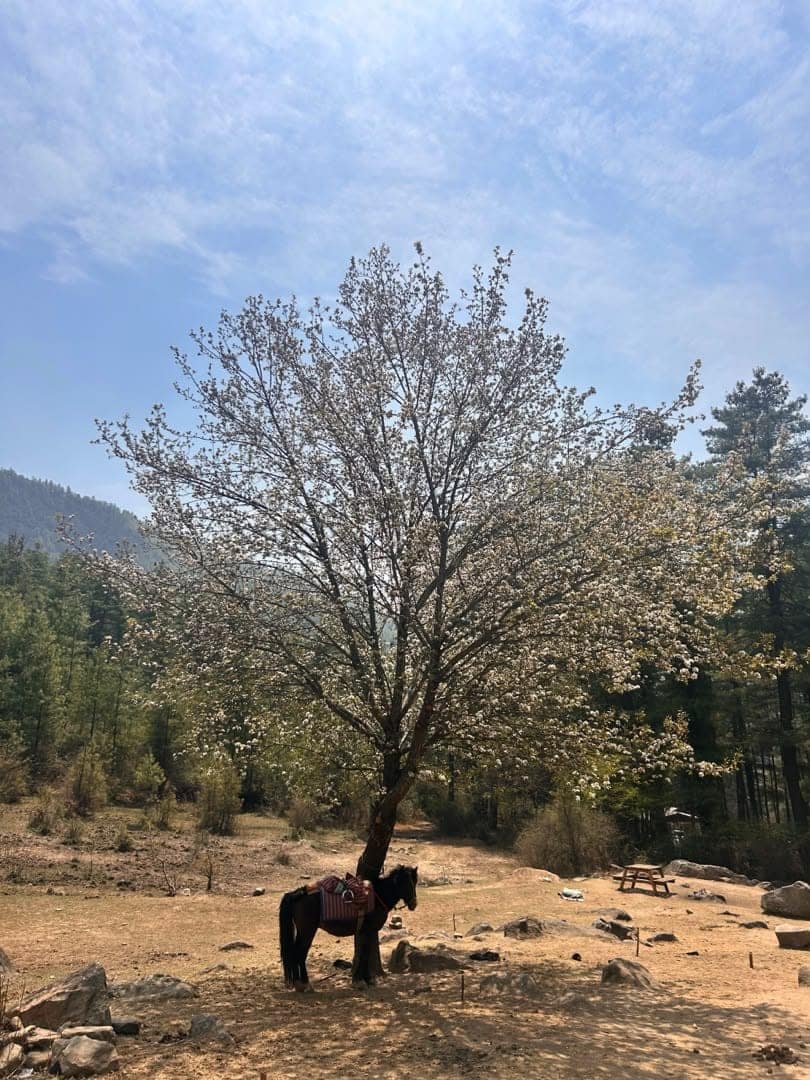
When visitors arrive at the base of Tiger's Nest and see the trail rising steeply into the cliff face above, some of them notice the horses. They are standing at the trailhead, available for hire, ready to carry people up the lower section of the mountain. It looks convenient. For some, it looks necessary.
I want to talk about those horses.
"Let the mountains be climbed without their suffering.
No view, no photo, no saved steps is worth their pain.
Walk instead."
What the Horse Ride Actually Covers
The horse ride is available on the lower portion of the trail — roughly the first third of the ascent, up to the cafeteria area. From there, the remaining climb to the monastery itself must be done on foot regardless. No horse goes to the top. The path becomes too steep, too narrow and too rocky.
So the horse ride does not take you to Tiger's Nest. It takes you partway up a mountain and leaves you with the harder half still ahead.
The Reality of the Horses
The horses at Tiger's Nest work hard. They make the same journey up and down the mountain many times each day, carrying tourists who are often heavier than what would be considered appropriate for the animal's size. The trail is steep, uneven and punishing on their legs and joints. In peak season, this happens hour after hour, day after day.
I have watched these horses for years. I have seen them breathe heavily on the descent, seen the marks left by saddles and harnesses, seen animals that are clearly exhausted pushed to keep moving. These are not animals living an easy life.
Bhutan is a Buddhist country. Compassion for all living beings is not a platitude here — it is a way of life. When you look at a tired horse on that trail and ask yourself whether the convenience is worth it, the answer the country itself would give you is clear.
Who the Horse Ride Was Intended For
The horse service at Tiger's Nest was originally intended for elderly visitors, people with mobility limitations or health conditions that genuinely prevent them from making the climb on foot. That is a reasonable and compassionate purpose. If you have a genuine physical need — a recent injury, a heart condition, severe arthritis — the option exists for you and that is understandable.
But for the majority of visitors who are physically capable of walking, there is no good reason to take it. The hike up to Tiger's Nest is manageable for most reasonably healthy adults. It takes two to three hours at a steady pace. It is not a technical climb. It does not require special equipment or training.
The Walk Is the Experience
I have guided hundreds of people to Tiger's Nest. Without exception, the ones who walked remember the journey as much as the destination. The prayer flags appearing through the pine trees as you gain altitude. The first glimpse of the monastery clinging to the cliff face. The sound of the waterfall below. The feeling in your legs when you finally arrive, knowing you earned it.
None of that exists if you ride halfway.
The walk to Tiger's Nest is not an obstacle between you and the monastery. It is part of the pilgrimage. People have been making this climb on foot for centuries. The difficulty is the point.
Start early — the ticket counter opens at 6am and that is a good time to begin. The trail is quieter, the light is beautiful and the air is cool before the crowds arrive.
Take your time — there is no prize for speed. Stop often, breathe, look around.
Wear comfortable shoes — proper walking or hiking shoes with grip. The path has some loose stone sections.
Bring water — and take your bottle back down — there is a cafeteria roughly halfway up but carry your own water from the bottom. And please, do not throw your empty bottle into the forest or off the trail just because your guide is not next to you or nobody is watching. Someone always finds it. Bhutan's mountains deserve better — and so do you.
Tell your guide your pace — a good guide will walk with you at whatever speed you need. There is no rush.
The descent is easier — coming down takes about half the time. Most people are surprised by how manageable it feels once they reach the top.
A Final Word
Bhutan asks its visitors to come thoughtfully. To leave the country better than they found it. Part of that is how you treat the mountain. Part of it is how you treat the animals that live and work on it.
Walk up to Tiger's Nest. Your body is more capable than you think. The view from the top — earned on your own feet — is one of the finest things you will ever see.
And the horses will thank you.